
Sometimes we discover a level of complexity in nature that fascinates us, and, from that moment on, our understanding of the world changes forever.
This is surely what happens to Ali Ozel when it comes to fluid dynamics. When he sees a car driving down an avenue, he thinks about the vehicle’s design and how it has been created with a specific aerodynamic profile in mind.
Perhaps when he turns on his shower tap, his mind analyses the tangle of pipes running through the building, pumping water in directions defying logic. Everything is permeated by fluid dynamics.
He probably didn’t have this in mind when he studied aeronautical and aerospace engineering in Turkey. However, something clicked at that moment: “I remember my first fluid dynamics class, I think it was in my second year of degree. At school, we were only taught the concept of flow, but I didn’t realise it existed on such depth: it’s something that’s everywhere!”.
After completing a master’s degree in environmental fluid dynamics, he obtained his PhD in Toulouse, France. Years later, he ended up becoming part of the SPARK-e team as a member of Heriot-Watt University, in Scotland. I suppose life has its own flows too!
The team led by Ali Ozel focuses on mathematical and computational modelling. They are our “eyes” before we can even see: they develop the models that explain what is going to happen, specifically, with heat transfer in electronic devices. “When you use a computer it consumes energy and, as a result, heat is generated in the processor is causing damage. That’s why we look for engineering solutions: to control or mitigate these problems before they even occur”.
In case the term ‘mathematical modelling’ hasn’t made it clear enough, the team at Heriot-Watt works with computers: they don’t have a traditional laboratory. However, their work tools are tremendously powerful, and thanks to computers, mathematical models describe the physical world in very different ways, starting with scale. “We work from the nanoscale to the chip scale, which is something we can physically see in our computers. However, there are processes we observe in chips that begin much earlier, at the atomic scale: one of them is the phenomenon of electron transport, which generates heat inside our chip.”
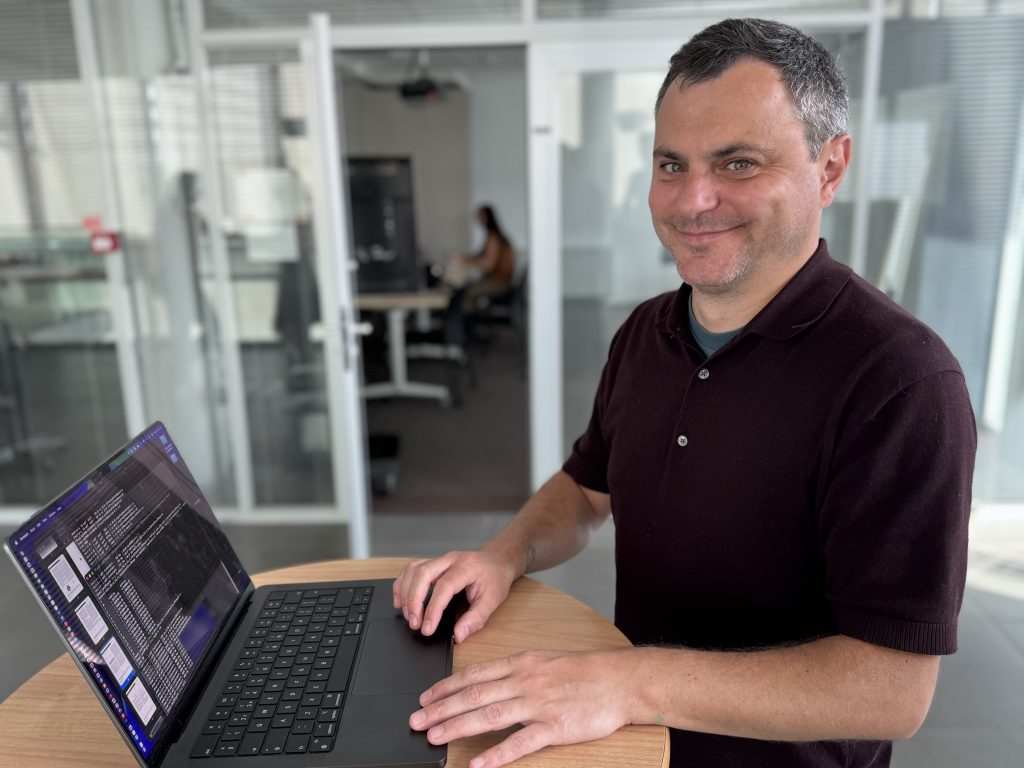
Currently, the team at Heriot-Watt together with CNR (our partner in Italy) are using quantum mechanical and kinetic models to describe what happens to atoms and molecules during phase transitions. Although these are phenomena that occur on an extremely small scale, the calculations involved are enormous. That is one of the biggest challenges Ozel’s team is facing.
When they develop a mathematical model, they obtain a result, or code, which is therefore used to generate a simulation. However, these simulations require a great deal of computational power. “Some simulations take months to complete, even when using more than 1.000 CPUs”, explains Ozel.
This is where the problems begin: it would be impossible to run all the simulations the team is working on, so they must choose which ones are the most promising to achieve the scientific objectives in SPARK-e.
Ozel’s favourite thing about his work is solving complex problems using equations: “I love the world of maths and computing. Nobody thinks it’s real, but to me it is”.
Finding answers often involves breaking down barriers, and that is exactly what the Heriot Watt team works on in SPARK-e. “When it comes to modelling, we’re going to push the boundaries completely, carrying out one of the largest simulations at the nanoscale,” says Ozel. “We’re developing a conceptual framework that is entirely new, and different from anything found in the previous literature.”
“I love the world of maths and computing. Nobody thinks it’s real, but to me it is”.
As the scientist from Heriot-Watt explains, although there are many research groups around the world developing “multiscale” mathematical models, which work taking different scales into account, none of them conduct studies from the nanometre scale to the chip scale. “This is the first time we’ve attempted to bring all these scales together. If it works and we achieve our goals, it will greatly expand our understanding of this field.”
By “all scales”, Ozel is referring to four basic units: nanoscale, sub-continuum, continuum and chip-level. For now, SPARK-e is making progress on the first two, thanks to the help of Heriot-Watt and our Italian partner, Consiglio Nazionale della Ricerca (CNR). Collaboration is essential to move forward, and for now, Ozel explains, it is working. “We already have a theoretical model, and we are waiting to receive the results of our simulations at the nanoscale. Once we have this, we will focus on preparing a more realistic setup for our Phase change materials,” he says.
In other words, the team led by Ozel wants to find out which position is most efficient for our material. To achieve this, they will place the material on the surface of the chip and compare its performance in different orientations, measuring which one achieves the greatest heat transfer.
Without all the work of our colleagues at Heriot-Watt, it would be impossible to consider a project as ambitious as SPARK-e. Their contribution is both unique and essential. Ozel himself is well aware of the variety of profiles involved in this project. “We have materials scientists, experimental chemists and systems and electronics experts, so this is a learning process for all of us given our very different backgrounds. We’re all, in one way or another, learning to work outside our comfort zones,” he concludes.
Because, if you want to change the rules of the game, you first need to colour outside the lines, don’t you?