
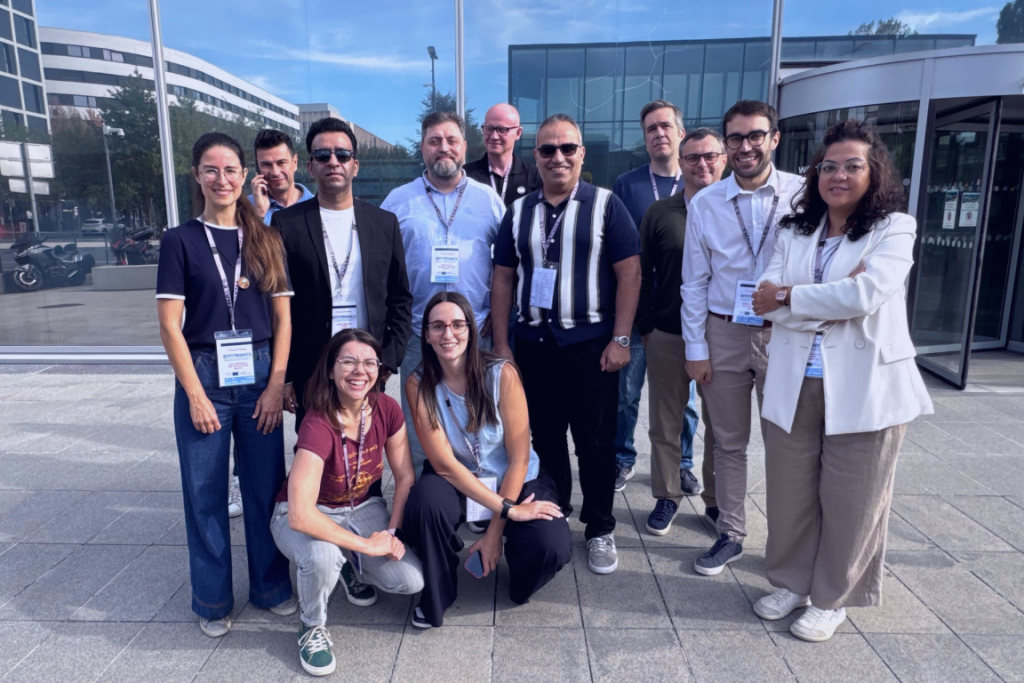
On the 2nd and 3rd September, the six projects of the Effitronics portfolio met face to face for the first time, hosted by Thales at its Palaiseau site near Paris. It was a milestone moment for this European Innovation Council (EIC) portfolio of projects, gathering over 40 participants from across countries to discuss together towards a realistic roadmap for the next years.
A warm welcome
The meeting opened with an introduction from Thales, who kindly hosted the event at their headquarters in Palaiseau, Paris, a generous gesture that set a collaborative and cooperative tone from the start. The floor first went to Isabel Obieta, the EIC Programme Manager who conceived the idea behind the Effitronics portfolio, which works on energy-efficient nanoelectronics for smart edge devices. As she prepares to leave her role, her address doubled as both a reflection on the portfolio’s origins and a formal handover to the incoming Programme Manager, Michael Bojdys, who is just stepping into the position.

Six projects, one stage
The heart of the first day was a round of presentations from all six projects in the portfolio, each sharing recent results, new papers, and ideas for cross-collaboration. SPARK-e’s own coordinator, Claudia Gómez Aguirre, from CIIAE, took the stage to present the project’s progress on phase change materials (PCMs) for efficient electronics. Her talk highlighted how PCM-based thermal management could become a genuinely cross-cutting solution for energy efficiency, with potential applications reaching well beyond SPARK-e and into other devices and technologies represented across the portfolio.
On Wednesday, 16 September, our coordinator will host a free webinar on our YouTube channel to discuss the innovative approach of SPARK-e. This session marks the beginning of a series of collaborations, with the different projects in our portfolio presenting their objectives and results via our platform over the coming months:
Overall, the six talks presented a promising picture of a portfolio with real technical and technological overlap, from 2D materials to neuromorphic computing to thermal management. Together, the projects have a bigger chance to achieve the goals of the EIC Challenge, to transfer the technology from lab to fab in a shorter timeframe.
Working Groups ready!
The afternoon of Wednesday 2 and the morning of Thursday 3 were dedicated to parallel sessions of the portfolio’s four Working Groups, each tackling a different strand of shared activity:
- WG1 – Technical synergies: technology synergies across the six projects, joint benchmarking and shared methodologies.
- WG2 – Outreach and public engagement: a joint strategy, focused on coordinated communication and dissemination of portfolio results.
- WG3 – Metrics of energy consumption: building a shared, harmonised set of key performance indicators for energy-efficient nanoelectronic edge devices.
- WG4 – IP Protection and exploitation: coordinated patent strategy, risk and competitive analysis, and support for exploiting portfolio results.
Laying the groundwork for the roadmap
The meeting closed with each Working Group presenting its conclusions to the full portfolio, setting the groundwork for the Effitronics portfolio roadmap. With a new Programme Manager now in place and a very productive in-person meeting, the portfolio heads into the future with real momentum, and a shared sense of collaboration and cooperation.
Related content: