

EXPLAINER
First came household appliances, such as fridges, washing machines and microwaves. Now, it’s also possible to check the energy efficiency of everyday electronic devices, including mobile phones, tablets and computers. The European Commission added all of them to the vast EPREL database, the European Product Registry for Energy Labelling.
Among other things, this initiative requires technology manufacturers to include energy labels on every product packaging. The EPREL website also acts as a repository – a public information service to easily search for specific device models.
But what is the point of all this labelling?
Responsible consumption and design: two sides of the same coin
Since 2025, EU regulations have required all smartphones and tablets sold in the European market to disclose clear energy labelling.
The evaluation criteria cover a broad range of metrics: battery life in hours and minutes per full charge, drop resistance, repairability, and protection against dust and water. This helps people to make informed decisions based on sustainability, thereby encouraging more responsible consumption.
The energy label cannot be understood without reference to another initiative proposed in 2023 – the Ecodesign Regulation 2023/1670, which sets out a series of minimum requirements for any technological device sold in Europe. This requires manufacturers to design products that are easy to disassemble and repair, and to make spare parts available on the market.
Furthermore, operating systems must provide software updates for a minimum of five years. The goal is simple: to make devices last longer and encourage repair instead of replacement, with features such as longer battery lifecycles and scratch and drop resistance.
A colour for every letter
If you look at an energy efficiency label, the first thing you’ll probably notice is the colourful rating scale with letters. Based on the Energy Efficiency Index (EEI), it ranks devices across seven distinct levels, ranging from A (highest efficiency) to G (lowest efficiency).
Although this scale provides a simple visual summary of a device’s energy efficiency, it is important not to rely on it alone. If we only consider this information, we risk overlooking other key factors, such as repairability.
So, what information can we glean from the whole energy label for our smartphone? Let’s take a look at the following example:
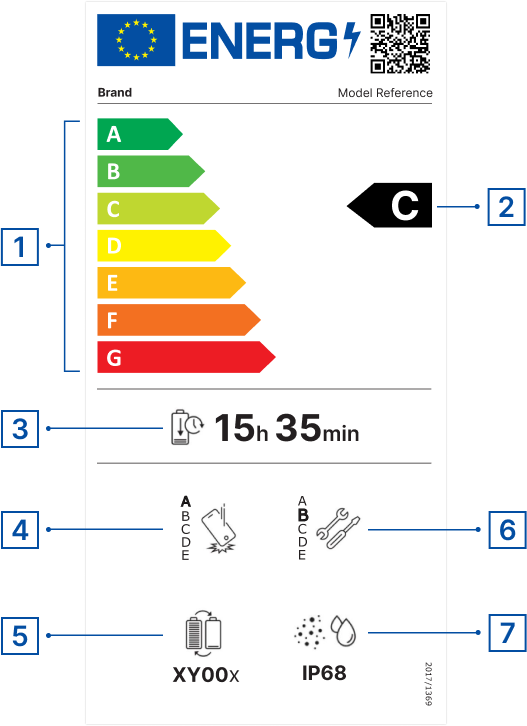
1.- As mentioned earlier, the first thing shown is the overall energy efficiency scale based on the EEI, ranging from A to G.
2.- The category on that scale corresponding to the product you are checking. In this case, it is the letter C, which tells us that this is a device with “high” efficiency.
3.- Battery endurance per cycle. This shows how many hours and minutes a full charge lasts on a device. In this case, the battery life is 15 hours and 35 minutes. This is quite low, as many modern devices already offer a battery life of over 70 hours!
4.- Repeated free fall reliability class. This measures a smart device’s impact resistance by testing its durability, determining the number of drops it can withstand before its functions are compromised. It includes five categories, ranging from A (most durable) to E (least impact resistant). In this case, the label shows that the device is highly resilient (category A).
5.- Battery endurance in cycles (not to be confused with point 3). This measures the number of charge and discharge cycles the device’s battery can endure before its capacity drops. This aspect is closely tied to the battery’s overall lifespan: once the number of cycles shown on the label is reached, battery life will decrease, meaning you will need to charge your smartphone or tablet more frequently.
6.- Repairability class. Another crucial aspect of the energy efficiency label is the repairability index, where A corresponds to the most repairable devices and E to those with the fewest repair options. This label has a fairly high rating of B.
7.- Ingress protection. Finally, this category defines how effectively the electrical enclosures of devices are sealed against foreign objects, such as dust and liquids. The label must display two digits: the first indicates the level of protection against solid objects on a scale from 0 (no protection) to 6 (complete protection). The second digit relates to protection against liquids on a similar scale, ranging from 0 (no protection) to 9 (protection against high-temperature, high-pressure water jets and steam). In our example, we see a dust-tight device (6) that could be submerged in water up to 1 metre deep without sustaining any damage (8).
How does energy labelling help us?
Energy labelling is mandatory for smart device manufacturers, so it is a reality that is here to stay, whether we understand its importance or not. However, we can use this regulation to make the best possible decisions, affecting not only our wallets but also helping the environment and sending a clear message to product designers: we want the very best because we know it’s an option.
Energy labelling provides us with an essential tool: a standardised model that allows us to compare products presenting the exact same information. Most of us are not tech experts (we’re just consumers!) so the energy label saves us hours on end scouring tech blogs for recommendations.
An energy-efficient device means two things: less charging time and a longer lifespan. And both translate, once again, into a key benefit: greater savings! Electricity bills will be lower, and you’ll use the same device for longer.
Energy labelling influences not only our purchasing decisions, but also the way manufacturers produce their goods. In a market a bit more free from tricks and obscurity, they must raise the quality of their products to remain competitive.
But regulations have their limits when it comes to the physics of our electronic devices. No matter how hard we try to extend the lifespan of our smartphones, if they constantly overheat due to poor heat dissipation, their circuits will eventually fail.
At SPARK-e, we aim to find our own solution to this problem, drawing on our core expertise: materials science. Thanks to our Phase Change Materials or PCMs, future devices will have a longer service life. Combined with more informed consumers and a more transparent market, this will create a much more sustainable and resilient future.
Consumption and design, manufacturers and users… we all play an essential role, and we can all make a difference through our actions. Energy efficiency isn’t just about regulatory compliance: it requires a cultural shift. Just as we value a mobile phone’s camera quality or a computer’s processing speed, sustainability needs to become part of the decision.